
Get Support
123-456-789-10
Cost of Building a Warehouse in Saudi Arabia
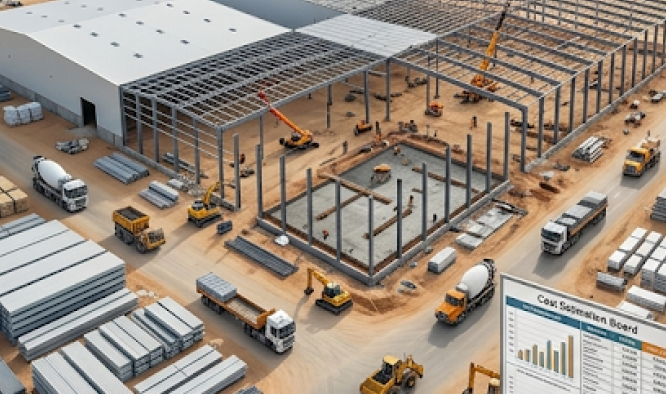
The cost of building a warehouse in Saudi Arabia is one of the most important topics business owners, factories, stores, and logistics projects search for before starting a storage or operational facility. A warehouse is not just a closed space for storing goods; it is a facility that requires careful planning in terms of area, location, structure type, flooring, insulation, safety systems, ventilation, lighting, and loading and unloading entrances.
The cost of building warehouses in Saudi Arabia varies from one project to another depending on the nature of use and operational requirements. A simple storage warehouse is different from an industrial warehouse, a distribution center, or a facility designed for food products or heavy equipment. Understanding the factors that affect the cost helps you set a realistic budget, avoid unexpected expenses, and choose the right structural solution for your project.
Main Topics in This Article
- Why does the cost of building a warehouse vary from one project to another?
- The impact of warehouse area on the final cost
- The role of structure type in determining construction cost
- The cost of land preparation and foundations before construction
- The importance of warehouse height and storage capacity in cost calculation
- The cost of industrial flooring and load-bearing capacity
- Thermal and waterproof insulation and their impact on the budget
- Electrical, ventilation, and lighting systems inside the warehouse
- The cost of gates and loading and unloading entrances
- Safety and fire protection systems inside warehouses
- Common mistakes that increase warehouse construction cost
- How to get an accurate cost for building a warehouse in Saudi Arabia?
1- Why does the cost of building a warehouse vary from one project to another?
The cost of building a warehouse varies from one project to another because each warehouse has a different purpose, area, and operational requirements. A warehouse used for storing light goods does not require the same specifications as a heavy equipment warehouse, a food storage facility, or a distribution center that operates throughout the day.
Therefore, it is not possible to determine an accurate cost without studying the project details, such as the structure type, flooring thickness, insulation type, number of gates, safety systems, finishing level, and operational requirements. The clearer the specifications are from the beginning, the more accurate and realistic the cost estimate will be.
- Nature of use: storage, distribution, operation, or heavy equipment.
- Required area: the larger the area, the more materials and work are needed.
- Technical specifications: such as insulation, flooring, and ventilation.
- Safety requirements: which vary according to the type of inventory and activity.
2- The impact of warehouse area on the final cost
Warehouse area is one of the most important factors affecting the final cost because increasing the area means increasing the quantity of steel or concrete, flooring area, insulation materials, lighting, ventilation, finishing, and preparation works. Therefore, the area should be determined based on actual need, not randomly.
Good space planning helps reduce construction waste and ensures that every part of the warehouse is used efficiently. The warehouse can also be designed in a way that allows future expansion instead of building a larger space than currently needed and paying unnecessary additional costs.
- Storage area: should match the volume of goods and how they are arranged.
- Movement routes: need planning to make worker and equipment movement easier.
- Loading areas: should be included within the operational space.
- Future expansion: reduces the need for reconstruction later.
3- The role of structure type in determining construction cost
The type of structure used in warehouse construction directly affects the cost. A warehouse can be built with a steel structure, concrete structure, or a combination of both depending on the project nature. Steel structures are usually suitable for large spaces and fast execution, while concrete structures may be suitable for certain projects that require special specifications or long-term durability.
Choosing the structure type should not depend on price alone. It should depend on use, loads, warehouse height, execution duration, expansion possibility, and maintenance requirements. The right choice from the beginning can save significant costs in the long term.
- Steel structures are suitable for fast execution and wide spaces.
- Concrete structures are suitable for some projects with special requirements.
- The structure type affects execution time, cost, and maintenance.
- Loads and storage nature should be studied before approving the structure type.
4- The cost of land preparation and foundations before construction
Before building the warehouse, the land and foundations must be prepared correctly because this stage affects the safety and load-bearing strength of the facility. The cost here includes soil study, site leveling, excavation, backfilling, foundation execution, level adjustment, and floor or slab preparation according to the type of use.
The cost of this stage may increase if the land is uneven, requires soil treatment, or if the warehouse is designed for heavy loads. That is why it is better to study the site carefully before starting execution to avoid surprises during construction.
Important note: Neglecting land and foundation preparation may reduce the initial cost, but it can cause structural problems, floor settlement, or major repair costs later.
5- The importance of warehouse height and storage capacity in cost calculation
Warehouse height is one of the factors that affect the cost because increasing the height means increasing the quantity of structure materials, cladding panels, insulation, lighting systems, and possibly ventilation or fire protection systems. However, the right height can increase storage capacity without needing to increase land area.
The height should be determined based on the type of goods, storage method, rack usage, forklift movement, and operational requirements. An unsuitable height may cause wasted space, movement difficulty, or unnecessary additional cost.
- Suitable height: helps use vertical space effectively.
- Higher storage capacity: through racks or layered storage.
- Higher cost: when height is increased without an actual need.
- Better operation: when forklift and equipment movement is considered.
6- The cost of industrial flooring and load-bearing capacity
Warehouse floors are not like ordinary floors because they may be exposed to forklifts, trucks, equipment, and heavy goods. Therefore, floor thickness, concrete type, reinforcement, curing, and final floor finishing are all elements that affect the cost of building a warehouse.
Choosing a weak floor to reduce the cost may lead to cracks, settlement, or difficulty in equipment movement, resulting in continuous maintenance and repair costs. That is why the floor should be designed according to actual loads and daily operational needs.
- Determining floor thickness according to load type.
- Using concrete suitable for the nature of operation.
- Considering forklift and heavy equipment movement.
- Executing a floor finish that supports easy movement and cleaning.
- Reducing cracks through proper design and execution.
7- Thermal and waterproof insulation and their impact on the budget
Thermal and waterproof insulation are important items that affect the cost of building a warehouse, especially in Saudi Arabia where temperatures are high in many regions. Good insulation helps reduce heat inside the warehouse, protect goods, improve the working environment, and reduce energy consumption when cooling or ventilation systems are used.
Waterproof insulation also protects the warehouse from water leaks and moisture, especially in roofs, walls, and joints. Although the cost of insulation may be higher at the beginning, it saves a lot of maintenance and inventory damage costs in the long term.
- Thermal insulation: reduces temperature and improves storage conditions.
- Waterproof insulation: protects from leaks and moisture.
- Long-term savings: by reducing maintenance and inventory damage.
- Choosing the right material: determines insulation efficiency and cost.
8- Electrical, ventilation, and lighting systems inside the warehouse
Electrical, ventilation, and lighting systems are items that must be included in the cost of building a warehouse because they affect operational efficiency, worker safety, and inventory management. A warehouse needs proper lighting distribution, practical electrical points, and possibly fans or ventilation systems depending on the activity type.
The cost of these systems varies according to warehouse area, height, number of operation zones, type of lighting used, ventilation requirements, and safety needs. Therefore, these systems should be designed from the beginning instead of being added randomly after construction is completed.
- Lighting: should cover storage areas, aisles, and loading zones.
- Electricity: includes panels, wiring, and required outlets.
- Ventilation: helps reduce heat and improve the working environment.
- Pre-planning: reduces modifications and additional costs.
9- The cost of gates and loading and unloading entrances
Gates and loading and unloading entrances are elements that may clearly affect warehouse cost, especially if the project depends on continuous truck movement or needs large gates, loading docks, or wide maneuvering areas. These elements are not decorative additions; they are an important part of operational efficiency.
The number, dimensions, and locations of gates should be determined based on goods and vehicle movement. An unsuitable design may slow down loading and unloading or cause congestion inside the site. The more organized the movement is, the faster and safer warehouse operation becomes.
- Determining the number of gates according to daily operation volume.
- Choosing dimensions suitable for trucks and equipment.
- Providing maneuvering areas to make entry and exit easier.
- Organizing loading and unloading zones to reduce waiting time.
- Connecting entrances with internal storage distribution practically.
10- Safety and fire protection systems inside warehouses
Safety and fire protection systems are essential items in warehouse construction cost because warehouses may contain goods and materials that can be damaged or flammable, and they also witness continuous movement of workers and equipment. Therefore, alarm systems, firefighting equipment, emergency exits, and safe movement routes must be considered.
The cost of safety systems varies according to warehouse area, type of stored materials, number of exits, nature of activity, and operational requirements. Although these systems may increase the budget, they are necessary to protect lives and property and reduce potential risks.
- Alarm systems: to detect risks early.
- Firefighting equipment: suitable for the type of stored materials.
- Emergency exits: clear and easy to access.
- Safe routes: for workers and equipment inside the warehouse.
- Risk reduction: through safe and organized design.
11- Common mistakes that increase warehouse construction cost
There are common mistakes that may significantly increase the cost of building a warehouse, such as starting execution without clear drawings, choosing an unsuitable area, neglecting soil study, poor insulation, or relying on specifications that do not match the nature of use. These mistakes may not appear at the beginning, but they cause additional costs during execution or operation.
Choosing a contractor based only on the lowest price may also lead to poor quality or uncalculated additional items. Therefore, the focus should be on clear specifications, accurate quotation, and the experience of the execution provider, not price alone.
Lack of prior study
Not studying the area, use, location, and loads may lead to costly modifications during execution.
Choosing the lowest price only
A low price without clear specifications may turn into a higher cost due to modifications and poor quality.
12- How to get an accurate cost for building a warehouse in Saudi Arabia?
To get an accurate cost for building a warehouse in Saudi Arabia, you should prepare a clear project concept that includes the required area, type of use, location, structure type, height, flooring, insulation, gates, electrical works, ventilation, safety systems, and any additional operational requirements. These details help prepare a realistic and complete quotation.
It is also better to request a detailed quotation that explains every execution item instead of relying only on an unclear total price. A detailed quotation helps you compare options, understand the real cost, and avoid disputes or unexpected expenses during project execution.
Define your needs accurately
Defining the type of use, area, and required preparations helps reach a cost estimate closer to reality.
Request a detailed quotation
A detailed quotation explains materials, stages, and specifications, making comparison between offers more accurate.
Do you want to know the cost of building a warehouse in Saudi Arabia?
Contact us now to get a suitable study for your project, including the area, structure type, insulation, flooring, gates, safety systems, and operational preparations, so you can get a clear estimate that helps you start your project with confidence.